 |
Glen Loth is a lonely little glen a mile or two south of the scattered township of Loth itself. The glen cuts due north through the hills of east Sutherland from the main A9 Brora to Helmsdale road to the Strath of Kildonan. A narrow, little-used single-track road runs through the glen and descends into the Strath of Kildonan above Duible; it meets the Kildonan road a mile south of Suisgill.
Glen Loth is one of those places which shows signs of habitation over a very long period. On a scarp above the main road at the entrance to the glen there is a tumbled broch. A few hundred metres further into the glen, Carn Bran is another better-preserved broch which lies across the waters of the Glen Loth burn. There are standing stones at two other sites in the glen.
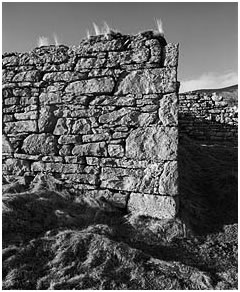
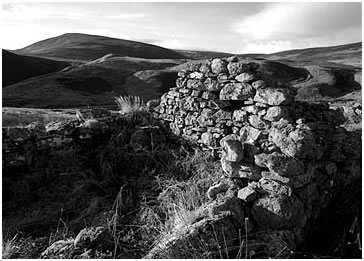
On the slope above the little road soon after it leaves the A9 there are many ruins; not much above knee-height but a sign that people lived here, once. Further up, into the glen proper there are further ruins across the stream. On the opposite side of the valley there is a substantial sheep-fank, created by the incoming Southern sheep farmers for whom the glen was cleared and probably still in use after the 2nd world war. Now it is the best-preserved ruin in the glen.
In the flat wet bottom of the Glen there are no real ruins to be seen; no-one would have choosen to live down there; a single shepherd's cottage has only recently lost its roof. At the north end of the glen, before it descends towards the Strath of Kildonan there are more low stone ruin beside the road and flattened, grassed-over walls which show where someone once lived, but no-one lives there today.
|
 |
| Glen Loth was cleared at the same time as nearby Kildonan, in three waves in 1809. 1813 and 1819. Across the county to the west, Strathnaver was burning. The recent biography of Patrick Sellar, who ruthlessly cleared these glens and town-ships, has a lot to say about the clearance of Glen Loth. |
Mr Dennis MacLeod looked into the distribution of the clans in the period immediately prior to the clearance of the strath.
He compared the number of entries recorded in the Kildonan parish register for each clan over the period 1795 to1815 with regard to births, and marriages. While this method is not as absolute as a census in determining relative numbers, it is nevertheless reasonably accurate because of the large number of entries (1400).
The number of entries should not be confused with population numbers which were probably about the 2000 level.The Sutherlands and Gordons made up 24% followed by the Mackays and the Polsons at 20%. the Gunns and Bannermans are also prominent at 13% and 7% respectively, followed by the Mathesons, Macleods and Macbeths. North Highland names comprised over 99% of the entries, the only exception being the Gilchrists.
|
The clearances psalm sheet.... Copy supplied by Kenny Mackenzie (red kenny the plumber)
This sheet belonged to a George Munro of Navidale (Kenny's great grandfather) who happened to be the Precentor that day. Shortly after the event the "toffs" came down with their hired "keepers" and forcibly removed all his papers photos etc. for burning. George had kept this order of service within a zipped bible and he challenged the intruder with the words "if you dare burn that bible you are really in trouble" this was enough to frighten him off , and so the bible was handed down to his son Angus who in turn gave it to Kenny in 1950.......
|
 |
In the 13th Century, the Seer Thomas of Erceldoune (a.k.a. Thomas the Rhymer or True Thomas) reportedly prophesied about the Highlands:
"The teeth of the sheep shall lay the (useless) plough up on the shelf."
Approximately 350 years later, Coinneach Odhar, the Brahan Seer,expanded on Thomas' vision:
The day will come when the Big Sheep will put the plough up in the rafters... ...the Big Sheep will overrun the country till they meet the Northern Sea... ...(and) in the end, old men shall return from new lands... |
The railway reached Helmsdale in 1870 and in the following years the line was completed to Wick. While the new line gave a boost to the fishing industry, it threw the remaining craftsmen in the parish, the shoemakers and tailors into poverty, as they were unable to compete with cheap factory made goods from the South.
Ultimately it was also the death knell of large scale sheep farming which was already in decline due to exhaustion of the arable land built up so laboriously by the cleared. From now on, the railway would provide easy access for the wealthy to enjoy their summer breaks - shooting deer or grouse and fishing for salmon. Fancy lodges would be built in the strath and increasingly, the shepherds would be cleared in their turn and the conversion to a man-made desert completed. |
A feature on the 'World Railways' website describes the inland route of the line, avoiding the steep Ord of Caithness, on its way to Wick.
The seashore is followed closely to Helmsdale where the route heads inland. This is spectacular country as the line threads its way up the Strath of Kildonan with signs of habitation decreasing as the coast is left further behind. Wild moors with snow fences along the line suggest that winters might be harsh. Small stations are passed without stopping - Kildonan and Kinbrace were both listed in the timetable as request stops. There was not even a sheep in sight! |
Chronolgy of the Clearances
1739 -- MacDonald of Sleat and Macleod of Dunvegan sell selected Clan members as indentured servants to landowners in the Carolinas.
1746 (April) -- Following the Battle of Culloden, surviving Highlanders are sent to the Caribbean as slaves.
1747 -- the Act of Proscription bans the wearing of tartan, the teaching of Gaelic, the right of Highlanders to "gather," and the playing of bagpipes in Scotland.
1747 -- the Heritable Jurisdictions Act forces Highland landowners to either accept all English jurisdiction or else forfeit their lands. Many Highland landowners and Clan chiefs move to London.
1762 -- Sir John Lockhart-Ross brings sheep to his Balnagowan estate, raises tenant rents, installs fences and Lowlander shepherds.
1782 -- Thomas Gillespie and Henry Gibson lease a sheep-walk at Loch Quoich, removing more than 500 tenants, most of whom emigrate to Canada.
1782 -- the Act of Proscription is repealed, but many Highland landowners, who have been born and raised in London or other metropolitan areas, remain in their urban homes, distancing themselves from the tenant Clan members on their lands.
1780s (late) -- Donald Cameron of Lochiel begins clearing his family lands, which span from Loch Leven to Loch Arkaig.
1791 --The Society of the Propagation of Christian Knowledge reports that over the previous 19 years more than 6,400 people emigrated from the Inverness and Ross areas.
1791 -- "The dis-peopling in great measure of large tracts of country in order to make room for sheep (is taking place)," observes the Reverend Kemp after visiting the Highlands.
1792 -- Sir John Sinclair of Ulbster brings the first Cheviot Sheep to his Caithness estates. These sheep would later be referred to as four-footed Clansmen, indicating the tenants' rage at being removed in favor of animals.
1792 (late July to early August) -- Angry tenant farmers drive all the Cheviots in Ross-shire to Boath. The 42nd Regiment intervenes, and the sheep are returned to Ross-shire.
1800-1813 -- Extensive clearances in Strathglass, Farr, Lairg, Dornoch, Rogart, Loth, Clyne, Gospie, Assynt, and lower Kildonan..
1801 -- The first clearances of the Strathglass area by William, the 24th Chisholm. Nearly 50% of the Clan living there are evicted.
1801 -- The emigrant ship The Sarah sails from Fort William to Pictou. By contemporary laws, only 489 slaves would have been allowed to be carried in the ship's holds. But no such laws govern emigrants, and almost 700 people are crammed into the ship, with nearly 50 people dying on the journey and countless others falling ill.
1803 -- Seeing their labor-base diminishing due to emigration, landowners in the Hebrides work for passage of the Passenger Act, which limits the number of people who can emigrate to other countries, trapping and keeping many tenants in poverty.
1807 (Whitsun) -- Evictions at Farr & Lairg -- the first major Sutherlandshire clearances.
1807 (October) -- The Rambler, carrying 133 emigrants from Thurso, sinks in the Atlantic. Only three passengers survive.
1807 (November) -- a gathering of The Northern Association of Gentlemen Farmers and Breeders of Sheep agree to move their activities into Ross-shire, Sutherlandshire, and Caithness. This decision would lead to massive clearances in those areas.
1809 -- The Chisholm enacts another large clearance of his lands in Strathglass, advertising to interested sheep-farmers lots holding between 1,000 and 6,000 sheep.
1811 -- More than 50 shepherds are brought into Sutherlandshire and made Justices of the Peace -- thereby giving them legal control over the native tenants.
1811 - 1851 -- The demand for seaweed (or kelp) falls. The harvesting of kelp was taken up by many cleared farmers who were relocated to the coast of Scotland. The lowering demands for kelp returns those farmers to poverty.
1813 -- Lord and Lady Stafford, the landowners of Sutherlandshire, hire James Loch to oversee the clearing of their lands.
1813 -- Nearly 100 tenants of Strath Kildonan emigrate to Canada aboard the Prince of Wales and settle near Lake Winnipeg.
1813 -- Sir George MacKenzie of Coul writes a book justifying the clearances, citing: The necessity for reducing the population in order to introduce valuable improvements, and the advantages of committing the cultivation of the soil to the hands of a few....
1813 (Spring) -- Lady Stafford writes that she would like to visit her Sutherlandshire estate but: at present I am uneasy about a sort of mutiny that has broken out in one part of Sutherland, in consequences of our new plans having made it necessary to transplant some of the inhabitants to the sea-coast from other parts of the estate
1813 (Spring) -- a group of Strath Kildonan residents march towards Golspie in order to have their grievances against the clearances heard. They are met by soldiers and the Sheriff, who, aided by local church ministers, intimidate the tenants into returning to their homes to await their eviction notices.
1813 (December 15) -- Tenants of the Strathnaver area of Sutherlandshire go to Golspie at the direction of William Young, Chief Factor for Lord and Lady Stafford. The tenants are told they have until the following Whitsunday to leave their homes and relocate to the wretched coastlands of Strathy Point.
1814 (April) -- Under the direction of Patrick Sellar, a Factor for Lord and Lady Stafford, heath and pastures surrounding Strathnaver are burned in preparation for planting grass for the incoming sheep. The native tenants of Strathnaver make no motion of moving to Strathy Point, or anywhere else.
1814 (June 13) -- Patrick Sellar begins burning Strathnaver. Residents are not given time to remove their belongings or invalid relatives, and two people reputedly die from their houses burning.
1815 -- The Sheriff-Substitute for Sutherlandshire arrests Patrick Sellar for:willfull fire-raising...most aggravated circumstances of cruelty, if not murder. Not surprisingly, a jury of affluent landowners and merchants acquit Sellar in April of sny crime.
1816. Soon after, Sellar continues clearing vast areas of Sutherlandshire.
1818 -- Patrick Sellar retires to his Sutherlandshire estate, given to him by Lord and Lady Stafford in acknowledgment of his work.
1819 (May) -- Another violent clearing of Strathnaver residents. Donald Macleod, a young apprentice stonemason witnesses: 250 blazing houses. Many of the owners were my relatives and all of whom I personally knew; but whose present condition, whether in or out of the flames, I could not tell. The fire lasted six days, till the whole of the dwellings were reduced to ashes or smoking ruins.
1819 (May) -- The Kildonan area is cleared. Donald MacDonald later writes: ...the whole inhabitants of the Kildonan parish, with the exception of three families--nearly 2,000 souls--were utterly rooted and burned out.
1819 (June) -- The Sutherland Transatlantic Friendly Association is formed to assist cleared tenants who wanted to emigrate to America. It generates little interest and soon folds.
1820 -- James Loch publishes his account of enacting the clearances, or, as he calls them, the improvements. He declares that Gaelic will become a rarity in Sutherlandshire.
1820 -- Journalist Thomas Bakewell severely criticizes both Loch's book and his actions during the clearances.
1820 (February and March) -- Hugh Munro, the laird of Novar, clears his estates at Culrain along the Kyle of Sutherland. A riot ensues when the Sheriff and military arrive to evict the tenants. Remonstrated by the minister Donald Matheson, the tenants eventually cease fighting and move away.
1821 (April) -- Officials bearing Writs of Removal for the tenants of Gruids, near the River Shin, are stripped, whipped, and their documents are burned. Fearing another riot like Culrain, military and police accompany the Sheriff back to Gruids where, faced with such strong opposition, the tenants gathered their few belongings and moved to Brora.
1826 -- The Island of Rum is cleared except for one family. MacLean of Coll pays for the other natives to emigrate to Canada.
1826 -- The emigrant ship James arrives in Halifax. Every person on board had contracted typhus during the voyage.
1827 -- Lady Stafford visits her Sutherland estate and receives gifts from the tenants. Those gifts, wrote Donald Macleod, were provided by those who would subscribe would thereby secure her ladyship's favor and (that of) her factors -- and those who could not or would not were given to understand very significantly what they had to expect by plenty of menacing looks and an ominous shaking of the head.
1829 (September) -- The Canada Boat Song, a poem protesting the clearances, appears in Scotland's "Blackwood's Magazine."
1830 -- Lady Stafford visits her Sutherlandshire estate and visits the tenants living in primitive sheds. Unable to comprehend how people could live under such conditions, but speaking no Gaelic, she is not able to ascertain the condition of her tenants lives.
1830 (October 20) -- While stonemason Donald Macleod was off working in Wick, his wife and children were surprised in their home: ...a party of eight men...entered my dwelling (at) about 3 o'clock, just as the family were rising from dinner.
The party allowed no time for parley, but having put out the family with violence, proceeded to fling out the furniture, bedding and other effects in quick time, and after extinguishing the fire, proceeded to nail up the doors and windows in the face of the helpless woman.... Messengers had (previously) been dispatched--warning all the surrounding inhabitants, at the peril of similar treatment, against affording shelter, or assistance, to wife, child, or animal belonging to Donald Macleod. ...After spending most part of the night in fruitless attempts to obtain the shelter of a roof or hovel, my wife at last returned to collect some of her scattered furniture, and (built) with her own hands a temporary shelter against the walls of her late comfortable residence...(but) the wind dispersed (the) materials as fast as she could collect them.
Buckling up her children...in the best manner she could, she left them in charge of the eldest (who was only seven years old), giving them such victuals as she could collect, and prepared to take the road for Caithness (in search of her husband). She had not proceeded many miles when she met with a good Samaritan and acquaintance...Donald Macdonald, who, disregarding the danger incurred, opened his door to her, refreshed and consoled her, and still under cover of night, accompanied her to the dwelling of (a friend), William Innes...of Sandside.
1832 -- Despite the fact that he forcibly evicted them, exiled members of Clan Chisholm swear allegiance to their chief back in Scotland.
1832 (late summer) -- Cholera runs through the Inverness area, claiming almost 100 lives. Many fear the illness came from the impoverished cleared tenants who beg on the streets, and strict laws are enacted to persecute these itinerants.
1833 -- At a party in honor of King William IV, Lord and Lady Stafford become the first Duke and Duchess of Sutherland.
1833 (winter) -- After the Duke of Sutherland's death, plans are made by some of the gentry for a monument to be erected in his honor. The tenants are "asked" to contribute, but Donald Macloed writes: all who could raise a shilling gave it, and those who could not awaited in terror for the consequences of their default.
1836 (autumn) -- a famine strikes the Highlands and Islands, leaving thousands to starve, despite efforts to fund emergency rations.
1837 -- The European historian/economist J.C.L.J. de Sismondi writes of Sutherlandshire: But though the interior of the county was thus improved into a desert--in which there are many thousands of sheep, but few human habitations, let it not be supposed by the reader that its general population was in any degree lessened. So far was this from being the case that the census of 1821 showed an increase over the census of 1811 of more than two hundred... the county has not been depopulated--its population has been merely arranged in a new fashion. The (Duchess of Sutherland) found it spread equally over the interior and the sea-coast, and in very comfortable circumstances--(but) she left it compressed into a wretched fabric of poverty and suffering that fringes the county on its eastern and western shores.
1840 - 1841 -- Donald Macleod publishes a series of letters in the Edinburgh Weekly Chronicle, describing his own eviction and other eyewitness testimony of the clearances.
1841 (February) -- Henry Baillie, Parliament Member for Inverness, forms a committee to investigate the situation in the Highlands. The committee concludes that there are too many people living in the Highlands and that a course of aggressive emigration should be established.
1841 (August and September) -- Given writs of removal by legal officials, the tenants of Durness and Keneabin riot and attack police and sheriffs with stones and sticks. Only after being threatened with an onslaught of military troops do the tenants accept the writs and grudgingly move away.
1845 -- Denied shelter within the church itself and believing themselves to be cursed by God, ninety evicted tenants of Glencalvie take temporary shelter in the churchyard at Croick, and leave messages scratched into the glass windows: ...Glencalvie people the wicked generation... ...John Ross shepherd... ...Glencalvie is a wilderness blow ship them to the colony... ...the Glencalvie Rosses...
1845 -- The potato blight, which had devastated Ireland the previous year, wipes out most of the potatoes in the Highlands.
1846 (December) -- The Reverend Norman Mackinnon of Bracadale Manse wrote to the Chaplain in Ordinary to Queen Victoria: Oh, send us something immediately.... If you can send but a few pounds at present, let it come, for many are dying, I may say, of starvation...
1847 (February) -- James Bruce, a writer for "The Scotsman," reports that the Highlanders' problems are due to their own laziness and suggests the best solution is for the native tenants: as soon as they are able to labour for themselves, be removed from the vicious influence of the idleness in which their fathers have been brought up and have lived and starved.
1849 -- Despite some rioting by the native tenants, Lord Macdonald clears more than 600 people from Sollas on North Uist.
1849 -- Thomas Mulcok, a somewhat bizarre writer and journalist with the Inverness Advertiser arrives in the Highlands and vigorously attacks landlords and factors in print. So vigorously, in fact, that he eventually flees to France when faced with charges of slander.
1850s (early) -- Clearances of thousands of tenants in the Strathaird district, Suishnish, and Boreraig on Skye; and Coigach at Loch Broom.
1851 -- Sir John MacNeill, under the direction of the Home Secretary, tours the Highlands and reports back that the Highland poor are "parading and exaggerating" their poverty and are basically lazy. The only solution MacNeill sees is emigration.
1851 (August) -- The clearance of Barra by Colonel Gordon of Cluny. The Colonel called all of his tenant farmers to a meeting to "discuss rents", and threatened them with a fine if they did not attend. In the meeting hall, over 1,500 tenants were overpowered, bound, and immediately loaded onto ships for America. An eyewitness reported: "...people were seized and dragged on board. Men who resisted were felled with truncheons and handcuffed; those who escaped, including some who swam ashore from the ship, were chased by the police...." When officials in Glasgow complained to the Colonel about many of Barra's homeless wandering their streets, he stated: "Of the appearance in Glasgow of a number of my tenants and cottars from the Parish of Barra--I had no intimation previous to my receipt of your communication. And in answer to your enquiry--what I propose doing with them--I say 'Nothing'."
1853 -- Knoydart is cleared under the direction of the widow of the 16th Chief of Glengarry.
More than 400 people are suddenly and forcibly evicted from their homes, including women in labor and the elderly. After the houses were torched, some tenants returned to the ruins and tried to re-build their villages. These ramshackle structures were then also destroyed.
Father Coll Macdonald, the local priest, erected tents and shelters in his garden at Sandaig on Loch Nevis, and offered shelter to as many of the homeless as he could. Donald Ross, a Glasgow journalist and lawyer wrote articles outlining the clearance of Knoydart, which generated little sympathy.
1854 -- The clearing of Strathcarron in Ross-shire. Some Clan Ross women tried to prevent the landlord's police force by blocking the road to the village. The constables charged the unarmed women, and, in the words of journalist Donald Ross: "...struck with all their force. ...Not only when knocking down, but after the females were on the ground. They beat and kicked them while lying weltering in their blood....(and) more than twenty females were carried off the field in blankets and litters, and the appearance they presented, with their heads cut and bruised, their limbs mangled and their clothes clotted with blood, was such as would horrify any savage."
1854 -- Archibald Geike, describing a recent clearance on Skye, states he saw: (The house was) a wretched hovel, unfit for sheep or pigs. Here 6 human beings had to take shelter. There was no room for a bed so they all lay down to rest on the bare floor.
On Wednesday last the head of the wretched family, William Matheson, a widower, took ill and expired on the following Sunday. His family consisted of an aged mother, 96, and his own four children - John 17, Alex 14, William 11, and Peggy 9 - the old woman was lying-in and when a brother-in-law of Matheson called to see how he was, he was horror struck to find Matheson lying dead on the same pallet of straw on which the old woman rested; and there also lay his two children, Alexander and Peggy, sick! Those who witnessed this scene declared that a more heart-rending scene they never witnessed.
Matheson's corpse was removed as soon as possible; but the scene is still more deplorable. Here, in this wretched abode, and abode not fit at all for human beings, is an old woman of 96, stretched on the cold ground with two of her grandchildren lying sick, one on each side of her.
1854 -- An emigrant ship is described by "The Times" as: The emigrant is shewn a berth, a shelf of coarse pinewood in a noisome dungeon, airless and lightless, in which several hundred persons...are stowed away, on shelves two feet one inch above each other...still reeking from the ineradicable stench left by the emigrants on the last voyage... After a few days have been spent in the pestilential atmosphere created by the festering mass of squalid humanity imprisoned between the damp and steaming decks, the scourge bursts out, and to the miseries of filth, foul air and darkness is added the Cholera.
1854 -- Highland landowners are asked to gather troops from their tenants to fight the Crimean War.
Most of the Highlanders refuse, one telling his laird: "should the Czar of Russia take possession of (these lands) next term that we couldn't expect worse treatment at his hands than we have experienced in the hands of your family for the last fifty years."
1856 -- The writer Harriet Beecher Stowe visits Sutherlandshire. Her tour is carefully orchestrated by the current Duchess of Sutherland to avoid sites of eviction, and so Stowe erroneously proclaims the tales of the clearances to be mostly fictional.
1872 -- A Parliamentary Select Committee is established to investigate claims that tenant farmers are being evicted in the Highlands to make room for deer. As the people had been cleared for sheep and not deer, the Committee finds no evidence.
1874 (spring) -- Starving tenants of Black Isle, Caithness and Ross areas attempt to commandeer grain shipments going from Lairds' estate farms to export ships. Military forces are called in to guarantee safe shipment of the grain.
1948 (November) -- The Knoydart area was originally cleared in 1853 by Josephine MacDonell and the former tenants were sent to Nova Scotia. Ninety-five years later, on 9-Nov-48, seven men who had served in World War II staked out claims on the Knoydart property, saying it was their right to stake out crofts on land that was being purposely left to go to waste. In the ensuing months, the 7 men gained the support of the populace, mostly due to the pro-Nazi philosophies of the then Knoydart laird, but a Court ruling eventually forcibly evicted the men.
1976 -- Crofters are legally allowed, for the first time, to purchase their own croft farms.
1993 -- The 130 tenant residents of Assynt raise £130,000 and, with the assistance of various grants and loans, buy their 21,000 acre homeland when it goes up for sale by the landowner. The Assynt Crofters Trust Ltd is established to oversee the land, instead of the traditional laird. A spokesman for the Trust states: "On the 1st February 1993 we became the first crofting communities to take complete control of our land. Our success means that we have put an end to the stranglehold of absentee landlords on the Crofting communities of North Assynt and set in motion an irresistible change in the land tenure system throughout the Highlands and Islands of Scotland.".
1994 -- Mr. Sandy Lindsay, a resident of Inverness and a former SNP councillor, initiates a movement to have the 27-foot red sandstone statue of the Duke of Sutherland, that sits atop Ben Bhraggie in the Golspie area, destroyed or removed.
Lindsay considers the statue offensive to the descendants of the tenants that the Duke removed from his lands. Lindsay gathers worldwide support and a petition is presented to the Highland Council's Sutherland Area Committee in May of 1996. The Council rejects the petition, but agrees to construct a series of information plaques describing the Clearances in the Ben Bhraggie/Golspie area.
1996 -- The Pictou Waterfront Development Corporation begins an effort to construct a replica of Hector, an emigration ship that brought 200+ passengers to Canada from Ross-shire.
1996 -- According to Auslan Cramb's Who Owns Scotland?, the top twenty landowners of Scottish lands are:
Domestic:
The Forestry Commission = 1,600,000 acres
Duke of Buccleuch/Lord Dalkeith: 4 estates in the Borders = 270,000 acres
Scottish Office Agriculture Dept: 90% crofting land = 260,000 acres
National Trust for Scotland: (including the 75,000-acre Mar Lodge) = 190,000 acres
Alcan Highland Estates: land used for electricity generation = 135,000 acres
Duke of Atholl, Sarah Troughton: Estates around Dunkeld/Blair Atholl = 130,000 acres
Capt. Alwyn Farquharson: Invercauld on Deeside & smaller estate, Argyll = 125,000 acres
Duchess of Westminster, Lady Mary Grosvenor: = 120,000 acres
Earl of Seafield: Seafield estates, Speyside = 105,000 acres
Crown Estates Commission: 3 main estates, including Glenlivert = 100,000 acres
International:
Andras Ltd, Malaysia: Glenavon, Cairngorms/Brauen, Inverness = 70,000 acres
Mohammed bin Raschid al Maktoum: = 63,000 acres
Kjeld Kirk-Christiansen, head of Lego, Denmark: Strathconon, Mid Ross = 50,000 acres
Profs Joseph and Lisbet Koerner, Swedish Tetra Pak heiress: Corrour, Caithness = 48,000 acres Stanton Avery, USA: Dunbeath, Caithness = 30,000 acres
Mohamed Al Fayed: Balnagowan, Ross and Cromarty = 30,000 acres
Urs Schwarzenberg, Switzerland: Ben Alder, Inverness-shire = 26,000 acres
Count Knuth, Denmark: Ben Loyal, Sutherland = 20,000 acres
His Excellency Mahdi Muhammad al-Tajir, UAE: Blackford, Perthshire = 20,000 acres
Prof. Ian Roderick Macneil of Barra, USA: Barra and islands = 17,200 acres
1996 -- Michael Foljambe, the landlord of the Melness Estate on the Kyle of Tongue, arranges for the free transfer of his lands to the resident crofters. The crofters set up Melness Crofters Estate Ltd. to govern their lands.
1997 (March) -- The 31-Mar-97 edition of The Scotsman reports: "The tenth Earl of Airlie, a former Lord Chamberlain to the Queen and brother of Sir Angus Ogilvy, has started an action to evict Norman Ogg, 58, a farmer, from his 125 acre farm on the 40,000 acre Airlie estate. "Nearby, in a separate action, Captain Alwyne Farquharson, chief of the Clan Farquharson and 16th baron of Invercauld, is trying to evict Jean Lindsay and her son, Sandy, from the 2,500 acre hill farm she has farmed for 26 years in Glenshee. "Capt Farquharson wants to extend the area available for grouse habitat -- and at Kinwhirrie farm, near Cortachy, Lord Airlie wants to improve the pheasant shooting."
1997 The residents of the Isle of Eigg raise over $2.4 million to buy their island from the landowner. Former laird Keith Schellenberg, who sold Eigg several years earlier, had called the island residents "drunken, ungrateful, dangerous and barmy chancers" and threatened them with eviction.
1997 (November) -- Klaus Helmersen, the Danish clothing manufacturing millionaire purchased the 42,000-acre Glenfeshie estate as a deer hunting estate, despite a campaign to make it public lands. A spokesman for Mr. Helmersen told The Scotsman: "We will not close it to people... we certainly do not want to stop ramblers or anyone else from coming on to the estate. We have public access laws in Denmark and are well used to allowing people into all forests."
1997 -- Scottish Industry Minister Brian Wilson outlines his Iomairt air an Oir (Initiative at the Edge) plan, to address issues such as depopulation in outlying areas of Scotland. The plan will involve Government agencies like the Crofters' Commission, Scottish Homes, Highlands and Islands Enterprise, and local authorities.
"Unless a difference is made in the next five to ten years, there are going to be more dead communities in the Highlands and Islands," Mr. Wilson told The Stornoway Gazette.
1997 -- The Scotsman reported that the owners of the Highland Spring mineral water bottling company are allowing the houses on their 3,000-acre Blackford estate in Perthshire "to crumble as they fall vacant."
Scottish National Party MP Roseanna Cunningham said "...the owners appear to be pursuing a policy of deliberately allowing perfectly serviceable properties to fall into disrepair rather than providing much needed rural housing."
1997 (November) -- The first new crofting community in more than 50 years is to be set up at the Orbost Estate on Skye. The Estate was recently purchased by the publicly-owned Skye and Lochalsh Enterprise, which plans to build about a dozen croft houses and farms.
1998 (March 13) -- A conference entitled The Western Isles: an Economy in Crisis meets to discuss the economic problems facing the Islands. Mr. Angus Graham, the vice-convener of the Western Isles Council told the newspaper the Electronic Herald that "...every day you hear stories from parents who are worried their young folk can't get work and will have to leave.
"Over the past four or five years we have been faced with a steady decline in some of our basic industries, industries that provided some kind of economic stability in the past: Harris tweed; fishing; fish-farming; the ability of the council to create employment through capital projects. We have seen our initial capital & consents progressively reduced: the current figure is 44.5% less than it was five years ago, and next year we expect it to be just about 50% less - an appalling reduction. The fish farming industry which was such a hope in the 1980s has rationalised to such a degree that the employment is almost half of what it was in 1987-88."
1998 (late April) -- the Scottish Landowners' Federation suggests that it is time to apologise for the Highland clearances.
1998 (April) -- From The Scotsman: The 6th Earl of Granville, the Queen's godson and a man whose favourite pastimes include scuba diving for scallops, is invoking an archaic law, "foreshore entitlement", which allows him to levy royalties on kelp harvested from his 60,000-acre estate in the Outer Hebrides.
While he sits in his elegant seven-bedroom mansion in Callernish accumulating royalty cheques, around 40 crofters on North Uist eke out a meagre living using sickles to hack tonnes of the crop from rocks jutting out of freezing Atlantic waters.
After labouring in the bitter cold for as long as eight hours a day, the cutters are likely to earn just £15.20 per tonne. On a good day they may receive £45 for the seaweed harvest, which is shipped to the mainland and turned into a thickening agent for toothpaste, ketchup and jam.
The 38-year-old Earl, Fergus Leveson Gower, is entitled to a percentage of the value of the seaweed crop simply because it is washed up on his piece of shore.
Earl Granville has done his best to defend the seaweed royalties, amounting to around £800 a year, saying the money was paid by the alginate company Kelco-NutraSweet and did not affect the price paid to cutters. However, the crofters say the Earl's argument is disingenuous. They argue the tax is passed on to them in the form of reduced rates for their crop.
1998 (May) -- From The Scotsman: The manager of the troubled Knoydart Estate has been sacked by his new landlords after he raised concerns over their takeover. Ian Robertson learned of the decision, which takes immediate effect, in a letter from John Turville, the recently-appointed managing director of Knoydart Peninsula Ltd (KPL), the company which owns the 17,000-acre estate. He has been told his actions amount to gross misconduct and ordered to clear his possessions from the estate-owned Farm Bothy at Inverie and vacate the house by 1 June.
1998 (September) -- The Scottish Secretary, Donald Dewar, announced that he wanted communities to have the right to buy the land where they lived; but said that the Government could not financially support each land purchase by local tenants.
Dewar suggested that legislation should be put into place that would give local people a pre-emptive right to purchase their land before an outsider has the opportunity to do so, and also should stop sales until an outside bid could be matched locally.
"We want to abolish the situation where people can wake up one morning and...discover someone or other, of whom they know not, is their new owner having had no discussion with him, know nothing about him and, in some cases, finding themselves at the mercy of someone with rather eccentric views."
1998 (September) -- From The Scotsman: Tony Blair is to announce plans to create a fund worth up to £150 million which could be used by local communities and conservationists to buy Highland estates such as Knoydart.
The measure follows long-standing controversies in Scotland over attempts by local communities and pressure groups to buy Highland estates of outstanding natural heritage or community value, like Glen Feshie in the Cairngorms, Knoydart or the Isle of Eigg.
1999 (February) --BBC Scotland Television presents, in Gaelic with English subtitles, Na h-Eilthirich (The Emigrants) an 8-part series that is "a controversial reassessment of the history of emigration from the Highlands and Islands over the past two centuries." The series attempts to show all facets of the emigration: from the Clearances to those Scots who left voluntarily and planned "theirdepartures down to the smallest detail."
1999 (March) - with assistance ranging from the John Muir Trust to theater impresario Cameron Mackintosh, locals of the 17,000+ acre Knoydart Estate purchase their lands. The newly-founded Knoydart Foundation pledges to "procure and manage for the benefit of the public the Knoydart Estate as an area of employment and settlement on the Knoydart Peninsula."
1999 (May - July) - the Scottish Parliament takes power and immediately addresses land reform, land ownership, and rural affairs issues.
2000 (March) - John MacLeod, the 29th MacLeod clan chief, puts the Black Cuillin mountains on Skye up for sale for £10 million. Local residents protest, sparking a debate about who actually owns the land and their rights to sell it.
|
|