|
An alternative history of The Clan MacLaren |
| By Peter Lawrie, ©2019 |
|
Two books on the “Stewarts of Appin” and the “Clan MacLaren” have been recently published by Hilton Lamar McLaurin, the fruit of many years of research by him. He says that Donald MacLaren is one of the most active of Scottish Highland clan chiefs and represents, by example, the role of a modern clan chief. However, McLaurin’s research has demonstrated that the MacLaren claim to be an ancient clan descended from the Earls of Strathearn is a fabrication based on a 19th century error. The 13th century Abbot Labhran, the supposed founder of the clan never existed. Much of the history published by the Clan MacLaren Society is fiction and a deliberate modern creation to transform a small clan in Perthshire with few followers into a large international clan The Earls of Argyll obtained authority as Royal Lieutenant over the area from 1475 and, as they did elsewhere, proceeded to place tenants amenable to their authority, supplanting the earlier inhabitants. Thus, it appears probable that both the MacLaren and MacGregor lineages were introduced to Balquhidder as the result of Campbell expansion at the start of the 16th century. |
|
The Clann Labhruinn or MacLaren According to the Clan MacLaren Society, the progenitor of the MacLarens was the medieval Abbot of Auchtow, who was kin to the Earls of Strathearn. Following the forfeiture of the last Gaelic Earl in 1344 his lands, including Balquhidder, were awarded to a member of the rising Stewart dynasty and later annexed to the crown by James II in 1436. [1] The MacLaren kindred, if they were in fact the Earl's descendants, had no legal title to any lands in Balquhidder until the present chief’s father, also Donald MacLaren, established his title as clan chief with the Lord Lyon court and purchased Achleskine house next to the kirk and some land around it, in 1957. An alternative view, from publications on the “Stewarts of Appin” and the “McLaurins and McLarens” by Hilton Lamar McLaurin, (both available on Amazon at time of writing), is that claims by the MacLarens of a distinct and once powerful clan in Balquhidder and Strathyre are based on errors in interpretation of 15th century documents by W F Skene in 1837 and the subsequent fervid imagination of James Logan in 1845. McLaurin's view is that the Abbot of Auchtow in Balquhidder never existed and that descendants of Vicar Laurance from Ardchattan on Loch Etive were minor tenants of the Stewarts from Appin, who were transplanted to the area around Loch Earn, including Balquhidder as part of the expansion of the Campbells in the early 16th century. [2] Balquhidder Balquhidder is said to derive from Gaelic both phuidir – pronounced Bo_fudj_yir - possibly meaning 'the dwelling or holy site of the Puidir'. This could be the name of a kindred of unknown date or the original name of the glen, from which the Pudrac, a monolith of probable Neolithic date, derived its name. Other authorities derive Both Fuidir to mean 'Fodder Homestead', suggesting good farmland. Balquhidder people are referred to in Gaelic as Puidirich. [3] Some MacGregors had this name, such as Alasdair pudrach (d.1598), a natural son of the chief Alasdair roy and brother of Gregor roy. The Barony of Balquhidder, a quarter of the whole glen and comprising the north side of the river Balvaig from Kingshouse up to Loch Voil, was granted by James IV to John Ross of Craigy in 1511, who sold it to David Lord Drummond in 1558. The Lordship of Balquhidder, comprising the south side of the river and the whole of the glen beyond Loch Voil, was first granted in 1500 to Janet Kennedy, mistress of James IV and subsequently, by James VI in 1587, to John Murray of Tullibardine. With respect to the Lordship, according to Nimmo's "History of Stirlingshire" (1817), Sir John Murray, was, in 1592, appointed Master of the King’s Household; created Lord Murray of Tullibardine on the 15th April 1604; and 1st Earl of Tullibardine on the 10th of July 1606. John had by Catherine, daughter of David, 2nd Lord Drummond, 4 sons, and 5 daughters. His fifth daughter married John MacGregor, also known as Iain glas, the brother of the 11th chief of Clan Gregor, Alasdair roy.” [This byname glas appears to have been a mistake for dubh or dow]. He was appointed Baillie of the Lordship lands. “As a son-in-law of Tullibardine, John MacGregor and his wife resided, before his death in 1603, at Innis-Mhic-Ghrighoir, or ‘Isle of MacGregor’, at the southeast extremity of Loch Voil in Balquhidder. The foundation of his castle, 20 feet wide and 66 long, existed within the memory of persons still alive (in 1817). John Glas MacGregor, as feudal vassal of Tullibardine, was granted the following lands in Balquhidder parish: Stronvar, Glenbucky, Gartnafuaran, Letchrich, Craigrich, Monachoil-Mor, Monachoil-Beg, Imerioch (now Newton), Invercharnaig, Inverlochlarig-Mor and all pertinents, Drumlich, Blarcrich. Invernenty, Monachoiltuarach, Murlaggan. The yearly value was 200 merks. By his lady wife, he had two sons, Gregor and Patrick. Following the battle of Glenfruin, in which his son in law was killed, Sir John Murray fetched home his daughter and grandchildren, and resumed possession of the abovementioned lands for their support. As a result of proscription, Gregor, (the 12th chief of Clan Gregor), assumed the name of Alexander Murray. [4] This account demonstrates the significance of the MacGregor presence in Balquhidder well before the time of Rob Roy and Iain oag beag. As Alasdair roy was childless at the time of his execution in 1604, it was John's children who would succeed as clan chiefs in the 17th century. In the early part of the 18th century the descendants of Lord Tullibardine, by then, Dukes of Atholl, appointed Iain oag beag, John Murray (alias MacGregor) of Glencarnaig succeeded by his son Robert Murray as their baillies for the whole of the Lordship. Iain oag beag is the ancestor of the present chief of Clan Gregor. The attack on the MacLarens in 1558 According to a 19th century inscription in the Balquhidder burial ground, in 1558 ‘incendiarists from Glen Dochart’ (meaning a band of MacGregors) attacked and murdered eighteen MacLaren families and took over their farms. [5] An earlier assault on Balquhidder by Duncan Ladasach may have occurred at Easter in the early 1540s in which 27 MacLarens were reported to have been killed. However it is possible there was just one attack, the date in 1540s may be correct and the inscription is therefore wrong. The surviving MacLarens appealed for aid to the Earl of Argyll who passed it on to Glenorchy (Grey Colin Campbell succeeded as Laird of Glenorchy in 1550). Between 1559 and 1561 most of the surviving MacLarens signed bonds of manrent giving their calp (allegiance) to Grey Colin in return for his ‘protection’ in place of their legal landlords. [6] Black Duncan succeeded in turning these bonds into charters of ownership of much of the land of the Barony. According to Dr Martin MacGregor, the Clan Gregor had been the ‘enforcement arm’ aiding the expansion of Campbells since the 15th century. So was Grey Colin behind the raid on the MacLarens? He, and his son Black Duncan (who succeeded him in 1583), repeated similar tricks on other kindreds throughout Southern Perthshire with the aim of obtaining legal claims over their land. [7] Despite being aided by the MacGregors up to then, in 1562 Grey Colin began the long conflict with the Clan Gregor when he refused to enfeoff Gregor Roy in Glenstrae. Grey Colin personally executed Gregor in 1570, but the conflict with Clan Gregor continued and culminated in the battle of Glen Fruin in 1603 as a result of which all MacGregors were proscribed by the crown. [ Sir Evan Murray MacGregor purchased a significant portion of the Barony lands from the Marquis of Breadalbane and built Edinchip House in 1830. Sir Gregor MacGregor, father of the present chief, sold the estate. Since Sir Evan, the clan chiefs have all been buried at the MacGregor mausoleum in the Barony ] |
A page on the website graveyardsofscotland.com has "The claim that Balquhidder Kirk burial ground was the burying place of Clan MacLaren is another mis-representation which has been repeated so often it is taken in some quarters as fact." The actual burial ground for MacLarens in the area is Leckine Cemetery, close to the fragmentary remains of the house of Ardveich at the southern end of Glen Beich where it joins Loch Earn. Ardveich was once the residence of one of the principal MacLaren family in the parish from the 17th century. An old plan of the Leckine burial ground indicates that sections were set aside for the MacLarens in Glen Artney, in Auchraw, in Ardveich and Auchtow. The webpage reports that it was exclusive to members of Clan MacLaren and the oldest burials are 17th century. It states "The Clan lived in this area for seven centuries, but they did not always bury their dead here. In fact, they were traditionally buried in Killin, a graveyard about ten miles away from Ardveich." [12] The claim of "seven centuries in the area" is what the webpage states, but in the light of McLaurin's work, it is probably a myth with no documentary evidence. |
 |
|
Balquhidder Kirk was a cemetery for all people in the parish in the 18th century. MacLaren burials are relatively modern. The oldest graves recorded at the Balquidder Kirk are primarily MacGregors with Rob Roy’s listed as one of the oldest. The oldest MacLaren burial is fifty years later in 1788 with the rest being late 19th and 20th century. Totting up from the list on findagrave.com of the currently extant memorial stones in the burial ground, there are 18 MacGregor dedications but only 15 MacLarens, which seems to contradict Donald's assertion that it is a "MacLaren kirk". [13] Donald MacLaren of MacLaren and Achleskine assumes that the MacLarens in the glen were more important in the 18th century than they actually were. Stewart’s book "Settlements in Western Perthshire” makes clear the relatively lowly status of the few remaining MacLaren households. [14] Stewart commented on page 174 "The decline of the indigenous (sic) MacLaren interest was most marked after 1665." |
 |
A book on the Stewarts of Appin and the Clan MacLaren has been recently published by Hilton Lamar McLaurin. He makes an interesting comment - "Donald MacLaren is one of the most active clan chiefs and represents by example what a modern Clan Chief's role is. Unfortunately, modern scholarship has shown that his lineage is a fabrication based on a 19th century error. The 13th century Abbot Labhran, the founder of the clan never existed. Much of the clan's history published by the Clan MacLaren Society is a fiction and a modern creation to transform a small clan in Perthshire with few followers into a large international Clan with sept names apparently carefully selected out of thin air.
[16]
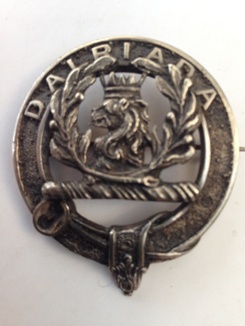
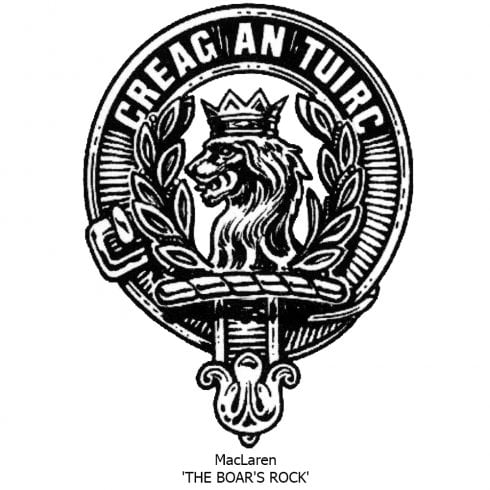
An example of this created history is "Creag an Tuirc" the new motto and gathering place of the clan created in the 1950s. The traditional motto was Dalriada referring to the origin of the clan on the West coast of Scotland in Lorne, which is the actual source of the clan's name, not a 13th century Abbot Labhran who never existed." |
 |
|
The Evidence Hilton McLaurin's evidence is compelling. The descendants of a "Vicar Laurancii" or Labhruinn were recorded at Kildonan, Ardchattan on the North Shore of Loch Etive in 1420. The ‘descendents of Laurence’ would have acquired the Gaelic name mhic Labhruinn (pronounced VicLaurin” = MacLaurin), thus recalling their descent from a well known and probably respected clergyman. [17] In 1435, Vicar Dubhghall Mac Ghille-Chriost mhic Labhruinn was recorded as a prebend to (the bishopric of) Lismore. (That is Dubhgall son of Gille Chriost, grandson, or descendent, of Labhrunn / Laurence). They were mentioned living in various places throughout Lorn in a document of 1463. McLaurins were also mentioned in the retinue of Dugald Stewart of Appin in 1463. Lord John Stewart of Lorn in 1473 married a MacLaurin woman from Ardveich on Loch Etive, Argyll, not from Ardveich on Loch Earn as claimed by the modern Clan MacLaren. The historian, W F Skene, in 1837 misidentified MacLaurins in a 1467 list, but nothing in Skene’s account mentioned Balquhidder, Ardveich or Strathearn. James Logan in his 1845 work, “McIan’s Costumes of the Clans” compounded Skene’s error by confusing Ardveich in Appin, with Ardveich on Loch Earn. Hilton McLaurin states that the two supposed MacLarens recorded in Balquhidder before 1464 were not MacLarens at all; The claimed existence of "Abbot Labhran of Achtow in Balquhidder" was due to a misreading by Logan of a damaged manuscript of 1467; and Loarn of Ardbechey in the “Ragman Roll” of 1296 was not ‘Laurence’ and therefore could not be a progenitor of the clan. The modern MacLaren "history" claims that Dugald MacLaurin, a supposed descendent of the Abbot of Auchtow in Strathearn, became the 1st Stewart of Appin in 1464. Hilton McLaurin says this claim cannot be substantiated and it is more likely that Dugald, the 1st Stewart of Appin, was in fact, a son of John Stewart, Lord of Lorn who was murdered in 1463. J & D Stewart in "The Stewarts of Appin", 1880, embellished the MacLaren claim by introducing Ardveich as the birthplace of Dugald's MacLaren wife and publishing a supposed 15th century poem as evidence. Dr Ronald Black, a celebrated Gaelic scholar, opined in 2016 that the poem was not written in 15th century Gaelic. but is very modern. [19] In 1475, James III appointed Colin Campbell, 1st Earl of Argyll, as his Lieutenant in areas which included Argyll & Lorn and, among other territories, Balquhidder. This authority was repeated by the crown for the Earl’s successors in 1504, 1525 and 1549. By 1500, the Stewarts of Appin had become bound as vassals to the Earl of Argyll. Although the King granted lands in Balquhidder to John Ross and John Murray, at the same time he had awarded the Earl of Argyll extensive legal powers over the same area. This combination of legal authority and the use of bonds of manrent allowed the Campbells, over time, to convert their authority into ownership of large areas of Argyll and Perrhshire. Appin men in the list of 1509 included a number of MacVicars which are noted as being MacLaurins. Recent DNA studies have confirmed the relationship of MacVicars from Appin with MacLarens and MacLaurins.In 1566, John Stewart, 5th of Appin signed bonds of manrent giving his allegiance to Colin Campbell of Glenorchy. The first documented existence of a MacLaren in Balquhidder was Malcolm Maklawryn with his three sons, recorded as joint tenants of Invernenty in 1512 along with McCoulcheire MacGregors. Further MacGregor kin groups were recorded in 1544 and 1558, in all probably under the direction of the Campbells of Glen Orchy. Conclusion The "mis-information board" which Donald MacLaren of MacLaren has paid for and had erected to attract the attention of visitors to the Balquhidder kirkyard is excessively negative. Donald tries to claim that Rob Roy is not buried here for two reasons: firstly that he does not like the volume of traffic which the name of Rob Roy generates to the glen; and secondly he is annoyed that Balquhidder has become known as a MacGregor glen. Both reasons are misdirected. In the first case, if traffic is excessive, he should press the local authority to improve the road to the Kirkton and provide more parking places for visitors. In the second, he should take advantage of the number of visitors to the kirkyard to accurately promote the history of Clann Labhruinn rather than denigrate that of Rob Roy and Clann Griogair. |